Antimony trioxide (ATO) is a true workhorse additive that rarely made headlines. Yet rising costs, shifting regulations, and unpredictable lead times have a way of turning a once-dependable additive into a trending topic. Across electronics, appliances, consumer goods, and industrial sectors, engineering teams are reassessing flame-retardant strategies and asking a practical question: how do we keep parts compliant, attractive, and moldable without relying on ATO-heavy systems?
To get a clear picture of what’s happening on the production floor, and what credible alternatives look like, we asked Heather Scaglione, Business Development Manager, High Performance Materials, and Jared Goble, Sales Director, Key Accounts for their input. They’re working directly with OEMs and processors who are weighing resin tradeoffs, testing new formulations, and trying to stay ahead of whatever supply shock comes next.
What is prompting manufacturers to revisit flame-retardant ABS and its ATO content?
Answer: The shift usually begins with volatility. Teams see price swings, longer lead times, and uncertainty tied to antimony sourcing. Once that shows up in new quotes and RFQ cycles, materials engineers start asking whether the original FR ABS still fits the program. The challenge is that molders often don’t have every CTQ from the OEM, so quoting becomes iterative. Assumptions change. Requirements get revisited. And no one wants to approve a material change until they understand the processing, cosmetic, and performance tradeoffs.
On the OEM side, the trigger is rarely a single factor. Some programs rely on FR ABS grades that hit demanding ratings at thin walls, targets like 5VA or specific glow-wire thresholds. When an antimony-based grade is doing the heavy lifting, switching isn’t automatic. Teams either adjust geometry or move up the performance ladder to something like FR PC/ABS. Both paths add validation steps, so the decision isn’t casual.
Where are engineering teams feeling the most pressure as they evaluate alternatives?
Answer: Wire and cable applications tend to feel it first simply because the FR loadings are high and the volume exposure is large. Electrical and electronics programs follow closely behind, especially where teams are already exploring halogen-free constructions. PFAS considerations add another layer in some formulations since certain additives support dispersion.
Appliances and consumer electronics feel it strongly. Those parts need to keep both their flame ratings and their appearance standards. Surface quality, gloss, and color consistency are non-negotiable. Any alternative chemistry has to deliver on safety and still meet cosmetic expectations.
When customers turn to Formerra for options, which antimony-free or lower-ATO material families realistically come into play?
Answer: Several families can work depending on the application. PA and PVC can be specified without antimony, though each brings its own processing considerations like drying, venting, thermal management, or corrosion concerns. Cosmetics determine whether they’re a fit for visible parts.
We also see FR PBT and FR PET evaluated for electrical applications, especially when teams want to keep the base polymer and simply move to an antimony-free FR package. In polyolefins, magnesium hydroxide and phosphorus-based systems are the usual paths, with the expected attention to flow, part geometry, and loading levels.
How practical is FR PC/ABS as a replacement for FR ABS? Where does it fall short?
Answer: For injection-molded parts, FR PC/ABS is often the most straightforward next step. It maintains moldability, tolerances, and surface quality while offering more heat resistance and impact strength. But it is not a one-for-one solution. Knit lines, venting, and thin sections may need review, especially on long flow paths. Drying becomes mandatory.
The benefit is that FR PC/ABS generally preserves the look and feel of FR ABS, including paint, print, and labeling compatibility. It tends to handle aesthetics well. For example, gloss and color depth are strong. The limitation is at very thin walls. Some ATO-based ABS grades still achieve higher ratings at the same thickness. If that requirement is fixed, teams may need a geometry change or a different resin family.
Are customers actively trialing these alternatives through Formerra?
Answer: Absolutely. Small appliances and consumer products are moving fastest. Sampling demand is strong enough that certain lines can be difficult to keep stocked. That tells you evaluations are wide-ranging and that anyone needing specific colors or UV packages should submit requests early.
We have multiple programs moving from FR ABS to FR PC/ABS today. In parallel, some teams are staying within their original polymer families but shifting from antimony-based FR systems to antimony-free equivalents. Those transitions tend to be easier because the base resin remains constant. Economics play a role too. As the cost gap narrows, the commercial barrier becomes less significant.
What compromises should customers expect as they move away from ATO-heavy systems?
Answer: Customers are asking if alternatives are feasible using a three-point checklist. First, what flame rating must the part achieve at its thinnest section? Second, will the part fill and pack consistently using the existing tool, especially if the FR system changes viscosity or venting needs? And third, can the appearance targets be matched reliably? This is especially important for parts that are white or light grey.
The main constraint is the rating at the thinnest walls. Some ATO-based grades still pass higher ratings where FR PC/ABS won’t. If thickness is mandatory, the options are geometry adjustments, rating changes if acceptable, or selecting a higher-performance polymer family.
When do inherently flame-resistant polymers become the right choice?
Answer: Miniaturized and high-heat environments are where higher-end polymers such as polysulfones, LCPs, PEI, and their peers excel. They often meet glow-wire and UL 94 requirements without thickening the part, which avoids mass and cooling penalties. But for high-volume applications, FR PC/ABS is usually the more economical and practical choice.
Higher-performance resins also simplify compliance across regions. The tradeoffs are predictably raised processing temperatures, narrower color windows, and the need for disciplined supply planning. Teams typically select them when the function, regulatory exposure, and value density justify the step up.
How are European regulatory trends shaping material decisions, even for North American programs?
Answer: European REACH considerations accelerate antimony-free evaluations. Even if a legacy FR package remains allowable today, many customers prefer to align with halogen-free or antimony-free systems for anything bound for Europe. Documentation expectations are rising as well. Programs want clarity on FR packages and intentionally added substances early in the process.
In North America, the initial driver is cost volatility. But once teams see the regulatory trajectory and the testing requirements across regions, many choose to standardize on antimony-free options where performance allows. They’d rather not revisit validation twice.
How does working with Formerra streamline the selection and validation process?
Answer: Formerra’s portfolio gives customers multiple paths to the same requirement. We can line up PC/ABS, ABS variants, PBT, PET, PA, PVC, or inherently FR materials and match each candidate to the flame rating, thickness target, cosmetics, and regional requirements. If something misses glow-wire or color targets, we shift to another chemistry without restarting the search.
And we stay involved through sampling, processing guidance, drying instructions, venting considerations, color management, and secondary operations like bonding or painting. We also map standards such as UL 94, IEC 60695, CTI, RTI, glow-wire, and FMVSS 302 against the part geometry so customers can see exactly which antimony-free paths fit. That reduces loops and gets programs validated sooner.
Miniaturized Electronics Making the Switch
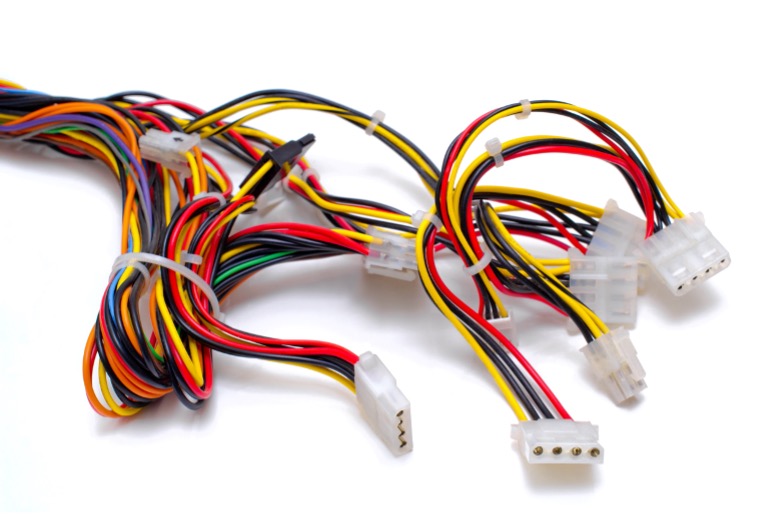
As housings shrink and operating temperatures climb, many compact electronics programs are actually stepping away from traditional FR ABS. FR PC/ABS often becomes the logical next step because it holds shape, passes key flammability tests more consistently in tight packages, and maintains a clean surface finish for visible parts.
Typical parts making the change include:
- Thin-wall housings for smart-home hubs, network devices, portable scanners, and compact consoles
- Battery and power-supply covers where heat and electrical spacing are critical
- Connectors, terminal blocks, and relay components that need dimensional stability under load
- Switches, plug bodies, and sockets with tight mechanical and electrical tolerances
- Control housings in small appliances or HVAC components where airflow and heat load concentrate
- Medical instrument shells such as diagnostic handhelds, portable monitors, power modules that require thin walls and consistent sterilization performance
| Inherently FR Polymers | ||
| Polymer | Supplier(s) | Description |
|---|---|---|
| PVDF | Syensqo. | Carbon-fluorine bonding. High limiting oxygen index and self-extinguishing. |
| PEEK | Evonik, Syensqo, Kingfa | Naturally flame resistant; inherently high limited oxygen index (LOI) and self-extinguishing. |
| PEI | Kingfa | Naturally flame resistant. High limiting oxygen index. |
| LCP | Celanese, Kingfa | Naturally flame resistant. Non-dripping. |
| PPS | Celanese | Naturally flame resistant. |
| PSU | BASF, Kingfa, Syensqo | Naturally flame resistant. (Sulfonyl group = highest oxidation state; attracts electrons from neighboring benzene) |
| PVC | GEON | Naturally flame resistant (due to presence of chlorine). Addition of other FR additives to enhance FR and help with smoke suppression. |
| Distinctions between inherently FR and FR-modified resins | ||
| Characteristic | Inherently FR Resin | FR-modified resins |
|---|---|---|
| FR Source | The chemical backbone of the polymer provides flame resistance. | Fire-retardant chemicals are added to the polymer blend. |
| FR Longevity | The FR properties are permanent and cannot migrate or leach out. | Additives can sometimes migrate out over time, reducing effectiveness. |
| Processing | May require specialized processing due to higher melting points or viscosities. | Processing is often easier, similar to base resin. |
| Mechanical Properties | Properties are often superior, maintaining integrity at higher temperatures. | Additives can sometimes compromise mechanical strength or other properties. |
| Environmental Impact | Generally preferred for meeting stringent "green" regulations like RoHS and REACH. | Halogenated additives, though effective, can produce toxic fumes. |


